Atuh Beach Nusa Penida
Nusa Penida has no shortage of dramatic beaches, but Atuh sits in a category of its own. It is the beach that does everything Diamond Beach cannot.
Diamond Beach is all about the view — a jewel-like strip of white sand framed by sheer limestone cliffs, stunning to look at, but off-limits for swimming. Atuh Beach, sitting in the very next bay, gives you that same dramatic setting — cliffs, crystal-clear water, a natural rock arch rising straight out of the sea — and lets you actually get in.
You can swim here. You can snorkel here. You can order a coconut from a beach vendor, sit under an umbrella, and do absolutely nothing for an hour. For an island known for its untouchable scenery, that combination is rare and worth seeking out.
This is the full guide to Atuh Beach — including local stories, the real name of the rock arch, and the one timing detail that most visitors get wrong.
The Story Behind the Name
Most visitors arrive at Atuh Beach without knowing what the name actually means — and it is a genuinely good story.
"Atuh" comes from two Balinese words: a meaning "not" and tuh meaning "dry." Put together: not dry, or more poetically — the one that never runs out.
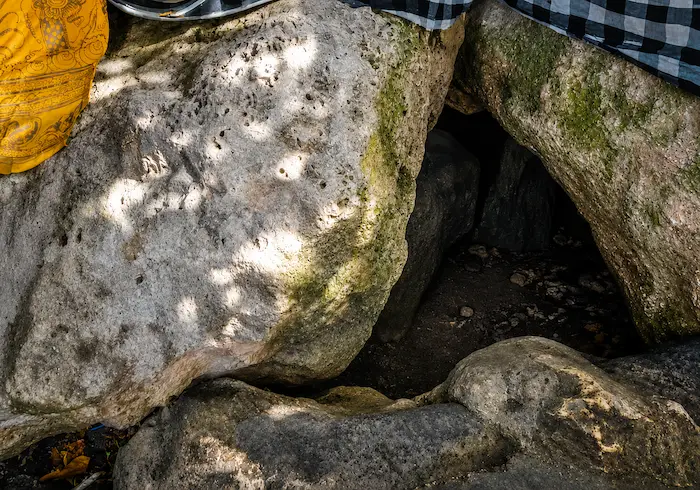
The name does not refer to the beach itself, but to a freshwater spring located just west of Pura Atuh, the small Hindu temple sitting above the beach. This spring is remarkable for one reason: it never dries up, even at the height of the dry season. Despite sitting right next to the saltwater ocean, the water from the spring is completely fresh and has served as a clean water source for the local community for generations.
According to local oral history, the spring was discovered after a villager witnessed a deer drinking water beneath a coconut tree during a drought. That night, the community received a spiritual sign — a pawisik — directing them to dig at the spot where the deer had been drinking. When they did, a freshwater spring emerged. Two springs were eventually found there, and both continue to flow to this day.
The beach took the name of the spring, and the spring gave its name to the temple. That is how Pantai Atuh came to be called what it is.
What Makes Atuh Beach Special?
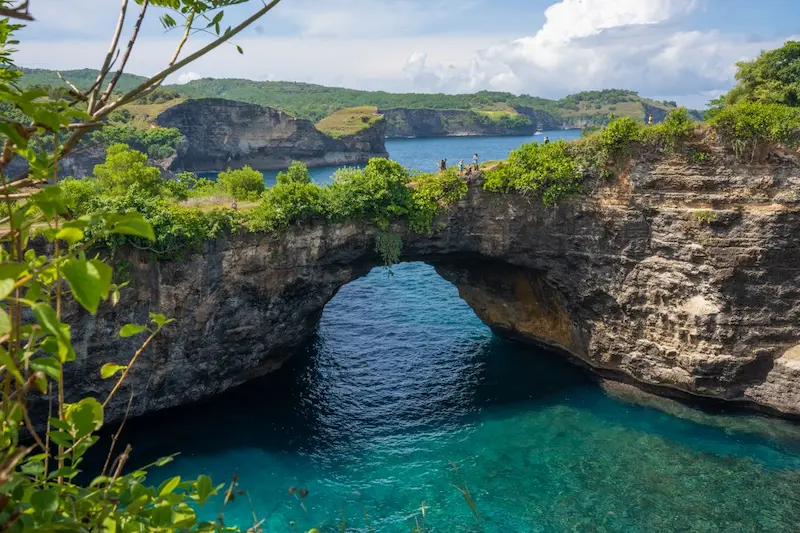
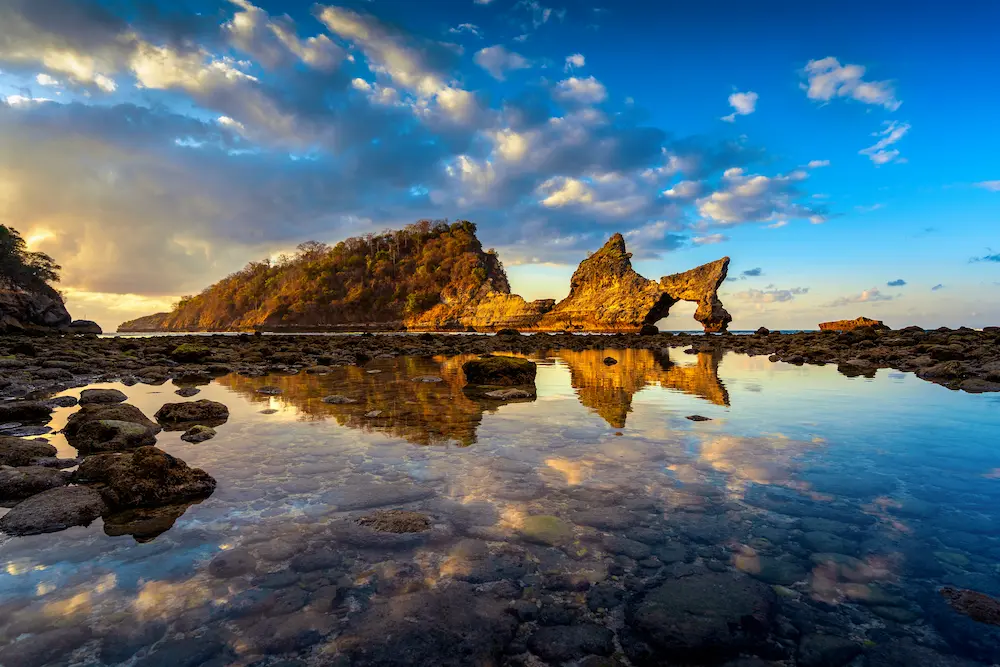
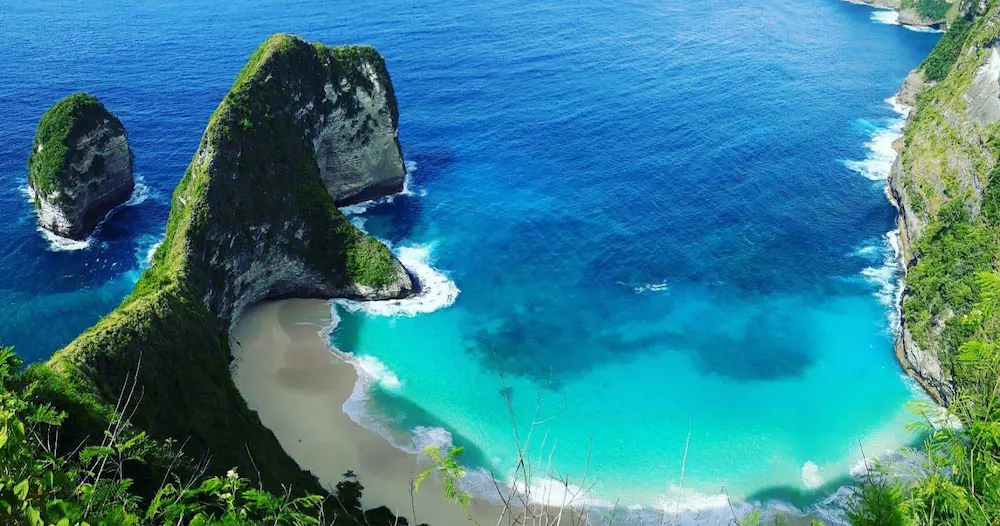
Atuh Beach is a white sand cove on the southeast coast of Nusa Penida, tucked beneath steep green cliffs in a natural amphitheater. The defining feature is the rock arch — a dramatic natural formation that rises out of the turquoise water just offshore.
This rock is known locally as Batu Melawang. What makes it unique is a natural hole at its tip, through which seawater passes — which is why locals also sometimes call it Batu Bolong (bolong meaning hollow or with a hole). Lush vegetation grows on top of the rock, and the land behind it has even been used by local residents for small-scale farming. It is far more than a pretty backdrop.
Beyond Batu Melawang, the bay is flanked by four named rock formations visible from the beach and clifftop:
- Batu Melawang / Nusa Batupadasan
- Batu Paon Island
- Batu Abah / Nusa Batuabah
- Jineng Hill Island
Some visitors describe the view from the clifftop — multiple rock islands scattered across vivid blue water — as reminiscent of Raja Ampat. It is a comparison locals are used to hearing.
One detail that almost no travel article mentions: before Atuh Beach became a popular tourist destination, the rock island area offshore was known locally as Pulau Sepatu — "Shoe Island." The name came from the shape of the rock formations as seen from the water. Long before the clifftop viewpoint drew crowds, this stretch of water was already a snorkeling destination — fast boats from Nusa Dua would make the crossing around the Kelingking and Nusa Penida coastline, with Atuh Bay as one of their regular snorkeling stops. The underwater terrain around the rock islands is the reason: coral, fish life, and clear visibility that made it worth the journey. That snorkeling heritage is still alive today, even if most visitors now arrive overland and look down from the cliff rather than coming in from the sea.
What sets Atuh apart from its famous neighbour Diamond Beach:
- You can actually swim here — one of the safer swimming beaches on Nusa Penida when tides are right
- Snorkeling possible directly from the beach around the rock formations
- Facilities on the beach — warungs selling food, drinks, coconuts, and sun lounger rentals
- Two access points — can be approached from two different cliff sides, with the southern route also connecting to Diamond Beach viewpoint
- Cultural depth — Pura Atuh, the sacred spring, and centuries of local history that most visitors walk right past
Location
Atuh Beach is located in Banjar Pelilit, Desa Pejukutan, on the southeast coast of Nusa Penida, Klungkung Regency.
GPS coordinates: -8.7477° S, 115.5388° E
There are two parking areas serving Atuh Beach — one on the northern side and one on the southern side. The southern parking lot also gives access to the Diamond Beach viewpoint, making it the more efficient choice if you are visiting both.
Download an offline map before heading out — mobile signal can be unreliable in this part of the island.
How to Get to Atuh Beach from Bali
Step 1 — Bali to Nusa Penida
Take a fast boat from Sanur harbour to Nusa Penida. Boats run from approximately 07:00 to 16:30, with the crossing taking 30 to 45 minutes. Tickets cost around IDR 100,000 – 250,000 per person one way. Book in advance during peak season (June to September).
You will arrive at Toyapakeh or Banjar Nyuh harbour on the northwestern side of Nusa Penida.
Step 2 — From the Harbour to Atuh Beach
Atuh Beach is on the east side of the island — the opposite side from Kelingking, Crystal Bay, and the other West Nusa Penida attractions. From the harbour, the drive takes approximately 60 to 90 minutes by car or scooter (around 25 km), crossing from the north coast to the southeast. The roads involve steep hills and winding sections. The final stretch approaching Atuh Beach is narrow and can be rough in parts.
Private Driver (Car) — Recommended
- Cost: IDR 500,000 – 700,000 per day
- The most comfortable option for the East Nusa Penida circuit. A local driver knows the roads, handles the navigation, and gives you flexibility to adjust your stops. Strongly recommended if you are combining Atuh Beach with Diamond Beach and Thousand Islands Viewpoint in a single day.
Scooter Rental
- Cost: IDR 80,000 – 150,000 per day
- Possible but demanding — the roads to the east coast are longer and more challenging than the west coast route. Only for experienced riders with full-day flexibility. Use offline GPS, as signal can be unreliable.
Local tip: Atuh Beach and Diamond Beach share the same parking area on the southern side — park once and visit both in the same stop. Add Thousand Islands Viewpoint and you have the complete East Nusa Penida circuit done efficiently. Check our [East Nusa Penida Day Tour] for a well-timed itinerary.
Entrance Fee & Practical Information
| Detail | Info |
|---|---|
| Entrance fee | IDR 60.000 per person covering both Diamond beach |
| Parking fee | IDR 5,000 |
| Opening hours | Sunrise to sunset |
| Facilities | Warungs, sun loungers, umbrellas, cold drinks, food |
Bring cash. Vendors on the beach sell coconuts, nasi goreng, mie goreng, cold drinks, and snacks. Sun lounger and umbrella rentals are available directly on the sand.
The Descent to Atuh Beach
Getting to the beach requires a descent from the clifftop parking area. The good news: it is significantly easier than Kelingking.
The walk down takes approximately 10 to 15 minutes on a steep path through dense trees and vegetation. Wooden handrails are in place along much of the route. The forest cover keeps it shaded for most of the descent, which is welcome in the Nusa Penida heat.
Two routes, one important tip: When you see the sign for "straight" and "left" at the fork, take the left. This route is easier, has better footing, and connects to a more gradual path to the beach. The straight route down the cliff face is significantly steeper and less forgiving.
What to wear: Closed-toe shoes with grip. The path is manageable in normal conditions but can become slippery after rain. Avoid visiting during or right after heavy rain — the trail gets muddy and the descent becomes hazardous.
The ascent back up will feel harder than the descent, especially in the midday heat. Bring more water than you think you need.
Note: Some sources mention the descent takes up to 30 minutes — in practice, a normal pace with stops for views takes around 15 minutes going down, slightly longer coming back up. Factor in the heat if you are visiting midday.
⚠️ The Most Important Timing Detail: Tides
This is the piece of information most visitors either miss or underestimate.
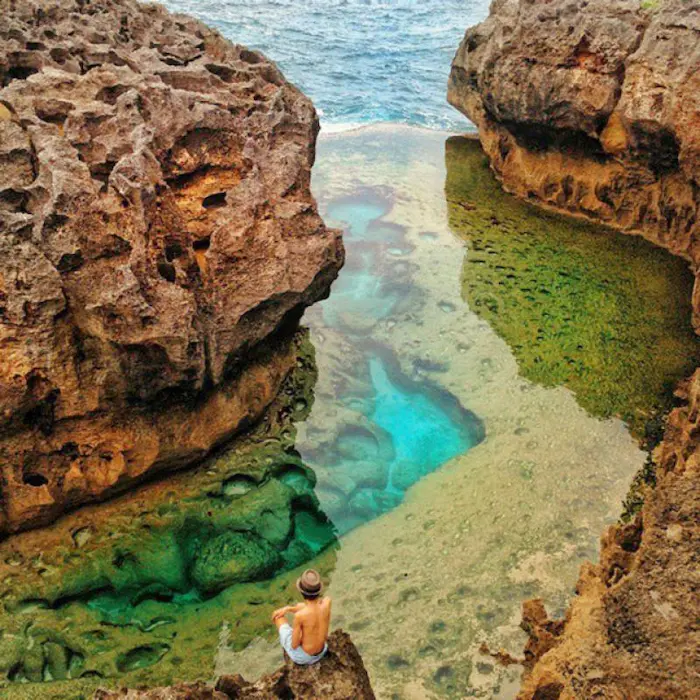
Atuh Beach is highly tidal. At low tide, much of the water recedes, exposing a rocky and shallow foreshore. At high tide, the bay fills with clear turquoise water and the beach becomes genuinely swimmable.
In simple terms: visit at or near high tide if you want to swim. At low tide, the water nearly disappears and the beach bottom becomes rocky and exposed — not ideal for swimming, though the rock pools reveal interesting marine life worth exploring.
Before you visit, check the tide schedule for Nusa Penida:
- Tides.net — search Nusa Penida
- Magic Seaweed — accurate for this area
A general guideline from locals: before 14:00 is usually the better window for swimming, though this varies daily. Always cross-check with the actual tide chart for your visit date.
Swimming is allowed at Atuh Beach, but there are no lifeguards on duty. Be aware of currents — the water inside the bay is calmer than open beaches on Nusa Penida, but currents strengthen the further out you go. Stay within the bay and avoid the rocky edges near the cliffs.
Best Time to Visit Atuh Beach
Best Season
The dry season, April to October, is the ideal time. Clear skies, calm seas, and the best water visibility for swimming and snorkeling. The limestone cliffs and rock formations photograph at their best under a deep blue sky.
The wet season (November to March) brings overcast conditions and rougher seas that can make the beach less appealing and the descent more hazardous.
Best Time of Day
- Sunrise (05:30 – 07:30): Atuh Beach faces roughly east — the beach catches the sunrise directly. This is the best window for photography, with golden light on the cliffs and rock arch, almost no one around. The best time to visit, according to locals, is as early as 05:30 for sunrise.
- Morning (07:30 – 11:00): Still excellent. Good light, manageable temperatures, fewer crowds than midday.
- Midday (11:00 – 14:00): Gets hot. Busiest period as day-trip groups arrive.
- Late afternoon (14:00 onwards): Crowds thin out as tours wrap up. Still good for swimming if the tide is right. Bring a torch or phone light if you plan to hike back up after 17:00.
Recommendation: Aim for early morning. Beat the crowd, catch the best light, and check the tide chart to confirm the water will be swimmable when you arrive.
Things to Do at Atuh Beach
Swim in the Turquoise Water
Atuh Beach is one of the best swimming beaches on Nusa Penida — a genuine rarity on an island where most beaches carry strong swimming warnings. At high tide the water is clear, calm, and genuinely inviting. Always assess the current before going in, and do not swim beyond the natural bay boundary. There are no lifeguards.
Explore the Rock Pools at Low Tide
If you arrive at low tide and swimming is not possible, do not write it off. When the water recedes, the exposed rock pools around the base of the cliffs reveal a different kind of beauty — coral formations, small fish, sea urchins, and other marine life trapped in the shallow pools. It is a completely different experience from high tide, and worth exploring carefully.
Snorkel Around the Rock Formations
The rocky base of Batu Melawang and the surrounding rock islands — known collectively in the old days as Pulau Sepatu — create excellent habitat for coral and fish. Before overland tourism took off, fast boats from Nusa Dua used to route all the way around to Atuh Bay specifically to snorkel here. The underwater terrain around these rock formations is genuinely good: healthy coral, varied fish life, and the kind of visibility that made this a snorkeling stop worth the long boat ride. Snorkeling directly from the beach is still possible in good conditions today. Bring your own gear — snorkel equipment is not reliably available for rental at Atuh Beach.
Visit Pura Atuh and the Sacred Spring
Most visitors walk right past it, but Pura Atuh — the small Hindu temple perched just above the beach — is worth a few minutes of your time. The temple is an active place of worship for Hindu communities from Pejukutan and the neighbouring village of Tanglad. The two freshwater springs in its western section, which have reportedly never dried up even through the driest seasons, are located nearby.
If you visit, dress respectfully — cover your shoulders and wear a sarong around your waist. Sarongs are often available to borrow at the entrance of temples on Nusa Penida. Do not enter temple structures without permission and be mindful if a ceremony is taking place.
Photograph the Bay from the Clifftop
The viewpoint at the top of the stairs shows the full amphitheater layout — beach, Batu Melawang arch, the four named rock islands, and the open ocean. Shoot this before going down; you will not get this angle from the sand. Some visitors describe the panorama as reminiscent of Raja Ampat — multiple rock islands scattered across vivid blue — and it is not an exaggeration.
Eat and Relax at the Beach Warungs
Unlike Diamond Beach, Atuh has a genuine beach infrastructure. Several small warungs line the back of the sand serving cold drinks, coconuts, nasi goreng, mie goreng, and basic snacks. Sun loungers and umbrellas are available to rent. This is the beach on the East Nusa Penida circuit where you actually stop, eat, and decompress.
Photography Tips for Atuh Beach
- Sunrise is the best light: The beach faces east — soft morning light hits the cliffs, the arch, and the water at the ideal angle. Arrive before 06:30 for the first light on the rock formation.
- Shoot Batu Melawang at mid-tide: Too low and the base is obscured by exposed rock; too high and waves reduce visibility. Mid-tide gives the clearest view of the full hole and arch structure.
- Clifftop before descending: The viewpoint at the top shows the full bay layout — beach, arch, four rock islands, cliffs — in one composition. Shoot this before going down.
- Look back from the water: Once near the water, turn around and face the cliffs. The perspective from below looking up at the towering limestone walls is dramatic and often undershot.
- Drone: The combination of the arch, the four named rock islands, and the surrounding cliffs makes Atuh one of the best drone locations on the island. Check current local regulations before flying.
East Nusa Penida Itinerary — Full Day
Atuh Beach sits at the heart of the East Nusa Penida circuit. Here is the full-day itinerary:
05:30 – 06:00 — Arrive at Atuh Beach viewpoint for sunrise. The cliffs catch golden light directly — photograph from the clifftop before descending. 06:30 – 09:00 — Descend to the beach. Swim, snorkel, explore rock pools, visit Pura Atuh, relax with a coconut from the warung. Tide conditions are typically best in the morning. 09:00 – 09:30 — Walk the short path to Diamond Beach viewpoint from the southern parking lot. Look down at Diamond Beach without descending — the view is outstanding. 09:30 — Drive to Thousand Islands Viewpoint (~15 minutes). One of the best panoramic viewpoints on the island — a cluster of small limestone islands scattered offshore, visible from a clifftop clearing. 11:00 – 12:00 — Lunch at a local warung near Thousand Islands. 12:30 — Begin the drive back to the harbour (~60–90 minutes) for the afternoon fast boat to Bali.
Optional additions:
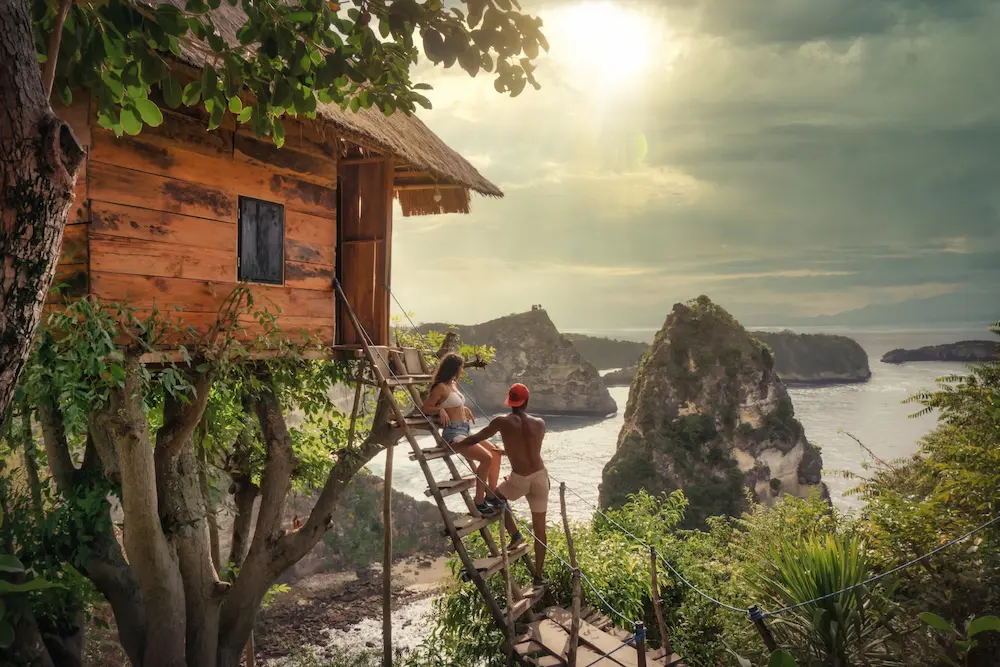
- Rumah Pohon Treehouse (Molenteng) — a wooden treehouse perched on a cliff near Atuh, with sweeping views toward Diamond Beach and Thousand Islands. Worth a 20-minute detour.
- Goa Giri Putri Cave Temple — a sacred Hindu cave temple where visitors crawl through a small opening that opens into a vast cavern. One of the most unique spiritual experiences on the island, best added as a morning stop before the beach.
- Teletubbies Hill (Bukit Teletubbies) — rolling green hills unlike anything else on Nusa Penida. Good add-on if you want variety beyond the coastal scenery.
FAQ
Can you swim at Atuh Beach Nusa Penida? Yes — Atuh Beach is one of the better swimming beaches on the island. The bay is naturally sheltered, keeping the water calmer than most Nusa Penida beaches. Swim at or near high tide for the best conditions. Always check the tide chart before visiting and be aware that currents strengthen further from shore. There are no lifeguards.
What does "Atuh" mean? Atuh comes from two Balinese words — a (not) and tuh (dry) — meaning "never dry." The name refers to a sacred freshwater spring near Pura Atuh that has reportedly never dried up even during the driest seasons, despite sitting right next to the ocean.
What is the rock arch at Atuh Beach called? The rock arch is called Batu Melawang by locals. It has a natural hole at its tip through which seawater passes, which is why it is also sometimes called Batu Bolong (bolong = hollow). Vegetation grows on top of it and locals have historically farmed the land behind it.
How do I get to Atuh Beach from Bali? Fast boat from Sanur to Nusa Penida (30–45 minutes), then a 60–90 minute drive (~25 km) to the east coast by private car or scooter. Park at the southern lot to access both Atuh Beach and the Diamond Beach viewpoint.
Is the descent to Atuh Beach difficult? No — the walk down takes 10 to 15 minutes and is steep but manageable. It is significantly easier than the Kelingking descent. Take the left fork when the path splits. Wear shoes with grip and avoid visiting right after rain when the path becomes slippery.
What is the entrance fee for Atuh Beach? Around IDR 60.000 per person, plus IDR 5,000 parking. Bring cash — there are no ATMs nearby.
When is the best time to visit Atuh Beach? Early morning during the dry season (April to October). The beach faces east so sunrise light is spectacular. Check the tide chart — high tide gives the best swimming conditions.
Is Atuh Beach the same as Diamond Beach? No — they are two separate beaches in neighbouring bays. Atuh has facilities, swimmable water, and the Batu Melawang rock arch. Diamond Beach is more visually dramatic from above but has no facilities and swimming is prohibited. Both can be visited in the same stop using the southern parking lot.
Is there a tour to Atuh Beach from Bali? Yes. East Nusa Penida day tours typically include Atuh Beach, Diamond Beach viewpoint, and Thousand Islands Viewpoint, with fast boat transfers and a private driver included. See our [East Nusa Penida Day Tour] for details.
Final Thoughts
Atuh Beach is the place on Nusa Penida where you actually get to be on the island rather than just looking at it from a cliff. The rock arch, the clear water, the beach warungs, the sacred spring with a centuries-old story, the short but rewarding descent — it is a complete experience in a way that many Nusa Penida spots are not.
The name says it all: never dry. There is always something here — always water in the spring, always life in the bay, always a reason to come back.
Check the tide, go early, take the left fork on the way down — and if you have time, stop at Pura Atuh before you leave.
Need help putting together an East Nusa Penida itinerary? Our team is based right here on the island. Take a look at our [East Nusa Penida tours] or [get in touch] — we know this circuit better than anyone.
For a complete overview of everything Nusa Penida has to offer, check out our Nusa Penida Travel Guide.
Questions about Atuh Beach or East Nusa Penida? Drop them in the comments — we answer from direct, on-the-ground experience.
Ready to visit? Book our Atuh Beach & East Nusa Penida Private Tour for a private, all-inclusive experience.
Want to visit Atuh Beach Nusa Penida?
This destination is included in several of our tour packages.
First time visiting Nusa Penida? Our complete Nusa Penida travel guide covers everything you need to know — best time to visit, getting there, and top spots not to miss.
Not a fan of heights? Our No-Cliff Guide covers flat, cliff-free spots you'll actually enjoy.