Angel's Billabong Nusa Penida
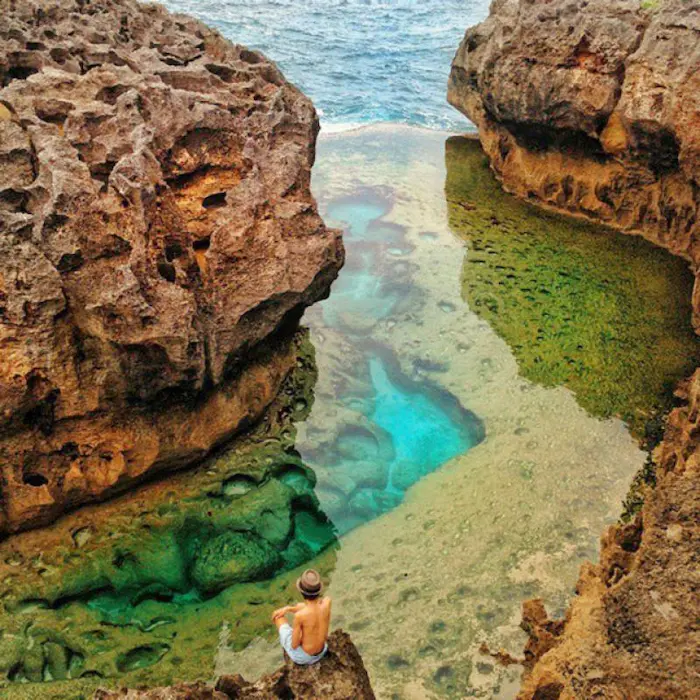
There is a moment that happens to almost every visitor at Angel's Billabong. You walk down the rocky path, round the last corner, and suddenly there it is — a perfectly still pool of crystal-clear water, perched right at the edge of a cliff, with the open Indian Ocean stretching out endlessly behind it.
It looks like someone built a rooftop infinity pool and then forgot to put a hotel around it.
But Angel's Billabong is entirely natural. Formed over centuries by the ocean carving into the volcanic rock along Nusa Penida's western coast, it is one of the most photographed spots in all of Bali — and one of the most misunderstood in terms of safety.
This guide covers everything you need to know before visiting, including the one thing most visitors get wrong: timing your visit to the tides.
What Is Angel's Billabong?
Angel's Billabong is a natural tidal rock pool on the western coast of Nusa Penida. The ocean has carved a series of interconnected pools into the volcanic rock at the cliff's edge, creating what looks like a natural infinity pool overlooking the Indian Ocean.
The name has two parts. "Angel's" is said to come from local legend describing the pool as a bathing place for celestial beings. "Billabong" is an Australian term for a still-water lagoon — fitting, because at low tide the pool becomes exactly that: calm, glassy, and serene, with water so clear you can see every pattern and texture on the rocky bottom.
The key word is low tide. At high tide, the same pool transforms completely. Powerful waves surge in from the open ocean, the water turns rough and murky, and the area becomes genuinely dangerous. The difference between the two states is dramatic — and understanding this is the single most important piece of information for planning your visit.
Location
Angel's Billabong is located on the southwestern coast of Nusa Penida, just a 5-minute walk from Broken Beach. Both attractions share the same parking area and are almost always visited together.
Address: Desa Sakti, Nusa Penida, Klungkung Regency, Bali, Indonesia GPS coordinates: -8.7262° S, 115.4617° E
Download an offline map before heading out — phone signal can be unreliable in this part of the island.
How to Get to Angel's Billabong from Bali
Step 1 — Bali to Nusa Penida
Take a fast boat from Sanur harbour to Nusa Penida. Boats depart regularly from around 07:00 to 16:30, with the crossing taking approximately 30 to 45 minutes. Book tickets in advance during peak season (June to August).
You will arrive at Toyapakeh or Banjar Nyuh harbour on Nusa Penida.
Step 2 — From the Harbour to Angel's Billabong
From the harbour, Angel's Billabong is about a 30 to 40 minute drive on the west coast route, depending on road conditions.
Private Driver (Car) — Recommended
- Cost: IDR 500,000 – 700,000 per day
- The west coast road has some steep and narrow sections. A private driver handles the navigation and lets you focus on the scenery. Best option if you plan to combine Angel's Billabong with Broken Beach, Kelingking Beach, and Crystal Bay in a single day.
Scooter Rental
- Cost: IDR 100,000 – 150,000 per day
- Only suitable for confident riders familiar with mountain roads. Take it slow — some sections of the west coast road are rough.
Local tip: Most day-trip tours from Bali reach Toyapakeh harbour around 09:00 and arrive at Angel's Billabong by 10:00. If you want to beat the crowds and catch the best tidal conditions, arrange your own transport and leave the harbour as early as possible — ideally by 07:30. Check our [West Nusa Penida Day Tour] for an itinerary timed around low tide.
Entrance Fee & Practical Information
| Detail | Info |
|---|---|
| Entrance fee | IDR 25.000 |
| Parking fee | IDR 5,000- 10.000 for car |
| Opening hours | Sunrise to sunset |
| Facilities | Warungs (food stalls), toilets near parking area |
The entrance fee sometimes covers both Angel's Billabong and Broken Beach together. Bring cash — card payments are not reliably available in this area.
The Most Important Thing: Tide Timing
This is not optional information — it determines the entire character of your visit.
Angel's Billabong behaves like two completely different places depending on the tide:
At low tide: The pool is calm, clear, and accessible. You can see straight to the bottom. The water is still enough to reflect the sky perfectly. This is the Angel's Billabong you see in photos.
At high tide: Waves from the open ocean surge into the pool without warning. The water turns rough and unpredictable. The area around the pool becomes dangerous, and the pool itself looks nothing like the photos.
Before you visit, check the tide schedule for Nusa Penida. Reliable sources:
- Tides.net — search for Nusa Penida
- Magic Seaweed — used by surfers, accurate for this area
Plan to arrive at Angel's Billabong at or near low tide, ideally within the two-hour window on either side of the tidal minimum. Early morning — before 09:00 — tends to align well with low tide conditions and also means fewer crowds.
Best Time to Visit Angel's Billabong
Best Season
The best time to visit is during the dry season, April to October, when the weather is calm. Clear skies bring out the best colour in the water — the emerald and turquoise tones that make Angel's Billabong look almost surreal.
The wet season (November to March) is still visitable but cloudy skies flatten the colours and waves can be more active.
Best Time of Day
- Early morning (06:30 – 09:00): Best window. During the dry season, the best time of day for calm conditions and sharp images is in the morning, 7:00 – 9:00 AM. Tidal conditions are most likely to be favourable, the light is soft and photogenic, and you will arrive before the day-trip crowds.
- Midday (10:00 – 14:00): Gets hot quickly. The pool may still look good if tides align, but expect more visitors and harsher light.
- Late afternoon (15:00 – 17:00): Late afternoon, between 3:00 PM and 5:00 PM, also offers softer lighting for photography. Worth considering if low tide falls in this window.
Bottom line: Check the tide chart first, then plan your arrival time around it. Tide beats clock every time.
⚠️ Safety Warning — Read This Carefully
This section matters. Angel's Billabong looks serene, but it has claimed lives.
Swimming at Angel's Billabong is not recommended and is now officially prohibited. Although the natural pool may look calm and inviting at low tide, conditions can change extremely quickly.
Multiple deaths have been reported at Angel's Billabong due to strong currents and sudden waves, even at low tide.
The danger is not obvious from looking at the pool. Waves do not announce themselves — a perfectly calm surface can be interrupted by a sudden surge from the open ocean that sweeps across the rock platform in seconds. There are no lifeguards, no warning systems, and the rocks around the pool are slippery and uneven.
Practical rules if you visit:
- Stay well back from the water's edge during anything other than clear low-tide conditions
- Never turn your back to the ocean when near the pool
- If you see other visitors in the pool during what looks like low tide, use your own judgment — do not assume it is safe just because others are there
- Get out immediately if wave activity starts increasing
- Keep children away from the water's edge at all times — no exceptions
The view from safely above the pool is genuinely stunning on its own. You do not need to be in the water to have a memorable experience here.
What to Do at Angel's Billabong
Photograph the Natural Infinity Pool
The main draw at Angel's Billabong is the view — and it earns every photo taken of it. At low tide, the pool sits perfectly still against the backdrop of the open ocean, creating the illusion of a seamless edge where the water meets the horizon. This is one of the most naturally beautiful compositions in Bali, and it requires zero effort to photograph well.
Walk the full perimeter of the rocky platform to find different angles. The edge-on shot with the ocean behind is the classic. The overhead angle (if you can find a higher rock to stand on) gives a different, almost abstract perspective.
Admire the Underwater Clarity
At low tide, the pool becomes calm and crystal clear, offering a unique and scenic spot. Even without entering the water, the visibility from above is remarkable — you can see the texture of every rock on the bottom, and in shallower sections, the play of light through the water creates shifting patterns that are mesmerising to watch.
Walk to Broken Beach
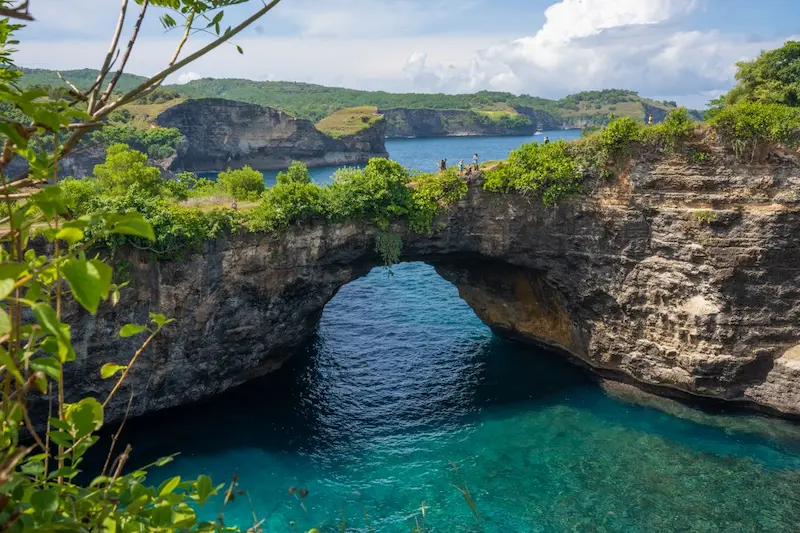
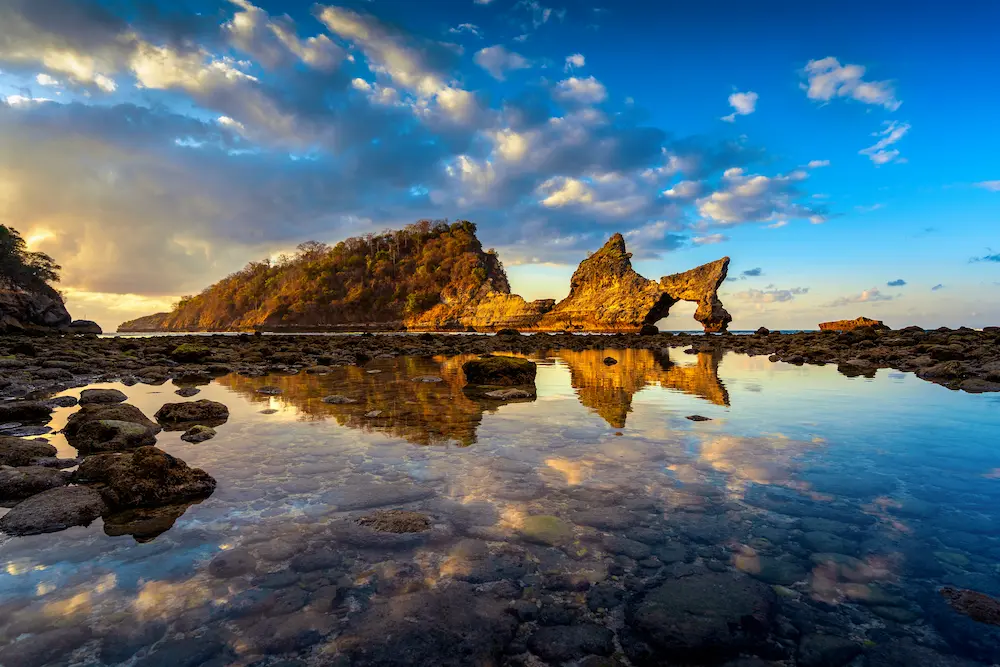
You cannot leave Angel's Billabong without visiting Broken Beach, an arched rock formation that connects Manta Bay and a circular inlet right at the edge of the ocean. The attraction is only a 5-minute walk from Angel's Billabong, past the warungs on the left and through to the other side of the trees.
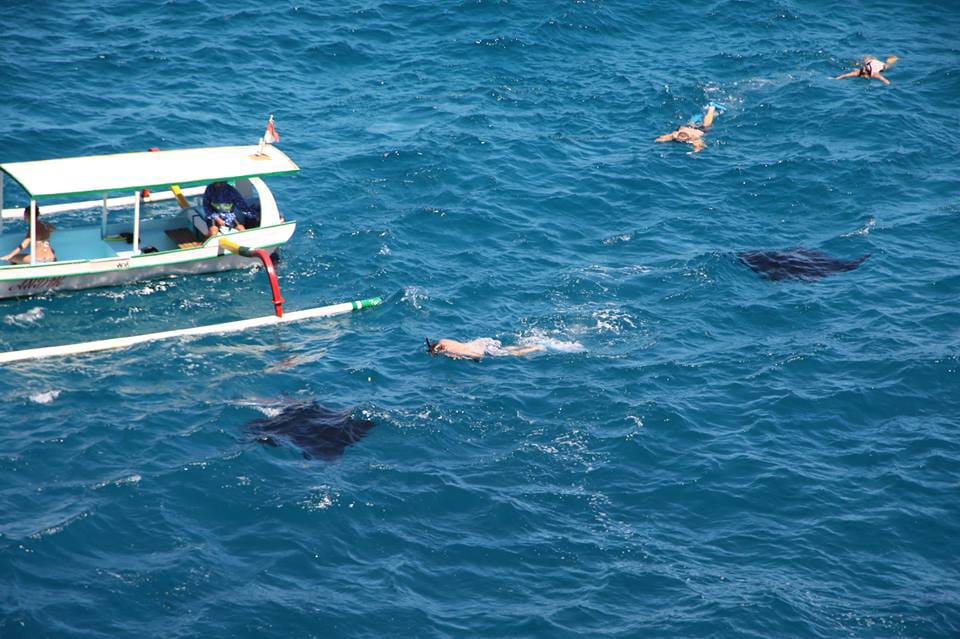
The trail between the two also passes the Manta Ray Viewpoint — a clearing where, in calm conditions and good light, you can sometimes spot manta rays moving through the water below. It is a short detour and absolutely worth taking.
Spot Marine Life from the Clifftop
Even without getting into any water, the clifftop platform above Angel's Billabong offers surprisingly good wildlife viewing. Manta rays pass through this area regularly, and on a clear morning with calm seas, their silhouettes are visible from above. Turtles are occasionally spotted too.
Photography Tips for Angel's Billabong
- Arrive at low tide: This is non-negotiable for the photos you have seen online. High-tide conditions produce murky, choppy water that photographs poorly.
- Shoot wide: The pool, the surrounding rock, and the ocean beyond are all part of the composition. A wide-angle lens captures the full context.
- Use the reflection: At low tide and in calm conditions, the pool surface reflects the sky. Shoot low to make the most of it.
- Include the ocean horizon: The "infinity" effect — where the pool edge appears to meet the open sea — is the defining shot. Position yourself so the pool and horizon align.
- Morning light is best: Soft, directional light from the east hits the pool and cliffs cleanly in the early morning. Avoid midday overhead light if you can.
- Be patient: Wait for the surface to settle between wave pulses before shooting. Even at low tide, occasional small surges disturb the surface briefly.
Nearby Attractions — West Nusa Penida Itinerary
Angel's Billabong sits at the heart of the best day-trip circuit on the island. Here is how to combine it efficiently:
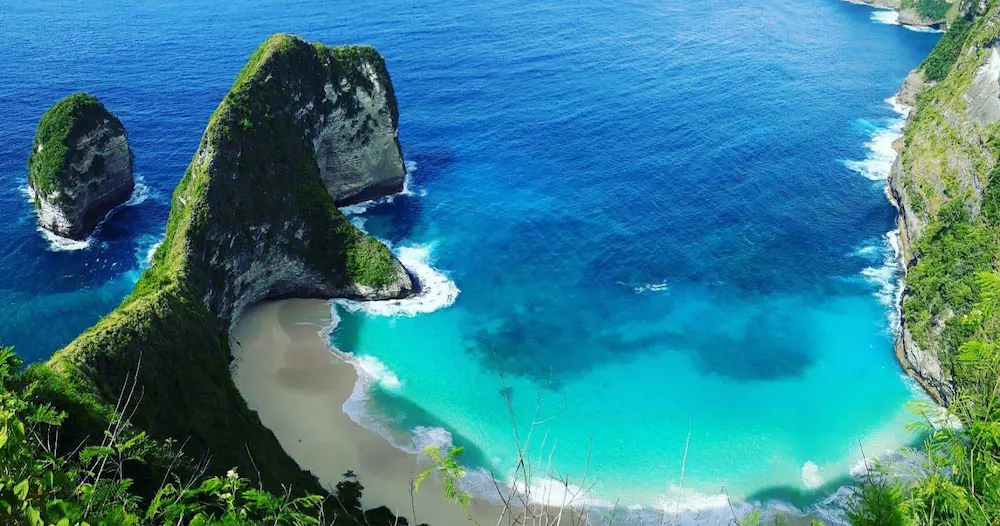
07:00 — Arrive at Angel's Billabong during or close to low tide. Explore the pool platform, photograph the infinity pool effect, check the Manta Ray Viewpoint. 08:00 – 09:00 — Walk to Broken Beach (5 minutes). Walk the full clifftop rim, photograph the natural arch from multiple angles. 09:30 — Drive to Kelingking Beach (~20–25 minutes). Stop at the upper viewpoint for the famous T-Rex cliff panorama. Optional: descend to the lower viewpoint or all the way to the beach (allow 1.5 hours for the round trip). 12:30 — Lunch at one of the warungs near Kelingking. 14:00 – 15:30 — Drive to Crystal Bay for a swim or snorkel in calm, protected water. 16:00 — Return to the harbour for the afternoon fast boat back to Bali.
This covers the four major highlights of West Nusa Penida in a single comfortable day.
FAQ
Is it safe to swim at Angel's Billabong? Swimming is now officially prohibited at Angel's Billabong following multiple fatalities caused by sudden waves and strong ocean surges. The pool looks calm at low tide but conditions can change instantly. The ban exists for good reason — treat it seriously.
What is the entrance fee for Angel's Billabong? As of 2026, the entrance fee is IDR 25.000 for adult and IDR 15.000 for children covering both Angel's Billabong and Broken Beach. Parking is IDR 5,000. Bring cash.
When is the best time to visit Angel's Billabong? Early morning during low tide, ideally between 06:30 and 09:00. Check a tide chart for Nusa Penida before your visit — the tidal window determines the quality of the pool conditions far more than the time of day does.
How far is Angel's Billabong from Broken Beach? About a 5-minute walk along a shaded path. They share the same parking area and are almost always visited together. The Manta Ray Viewpoint is along the connecting trail.
How long should I spend at Angel's Billabong? Around 30 to 45 minutes at the pool itself is enough to explore the platform and take photos. Combined with the walk to Broken Beach and the Manta Ray Viewpoint, allow 1.5 to 2 hours for the full stop.
Can children visit Angel's Billabong? Yes, but close supervision is essential at all times. Keep children away from the water's edge and the pool perimeter — the rocks are uneven and slippery, and the ocean side of the platform has no barriers.
Is there a tour that includes Angel's Billabong from Bali? Yes. West Nusa Penida day tours typically include Angel's Billabong, Broken Beach, and Kelingking Beach, with fast boat transfers and a private driver arranged. See our West Nusa Penida Tour for details.
Final Thoughts
Angel's Billabong is one of those places that is genuinely hard to believe until you are standing in front of it. A crystal-clear natural pool, completely open to the sky, perched at the edge of a cliff with the Indian Ocean pouring in from below — it is the kind of thing that makes you feel like the world still has secrets left.
Come at the right tide, bring a wide-angle lens, and take your time on the rocky platform. You will leave with some of the best photos of your Bali trip.
Just respect the ocean while you are there. It built this place over centuries, and it does not care how calm the surface looks.
Need help planning your West Nusa Penida day? Our team is based right here on the island and knows it better than anyone. Check out our [West Nusa Penida tours] or [get in touch] — we will handle the details.
For a complete overview of everything Nusa Penida has to offer, check out our Nusa Penida Travel Guide.
Any questions about Angel's Billabong or Nusa Penida? Drop them in the comments below — we answer from direct, on-the-ground experience.
Ready to visit? Book our Angel's Billabong Private Tour from Bali for a private, all-inclusive experience.
Want to visit Angel's Billabong Nusa Penida?
This destination is included in several of our tour packages.
First time visiting Nusa Penida? Our complete Nusa Penida travel guide covers everything you need to know — best time to visit, getting there, and top spots not to miss.
Not a fan of heights? Our No-Cliff Guide covers flat, cliff-free spots you'll actually enjoy.