Understanding Indonesian Rupiah: A Local's Guide (So You Don't Pay Rp 500,000 for a Coconut)
July 19, 2026
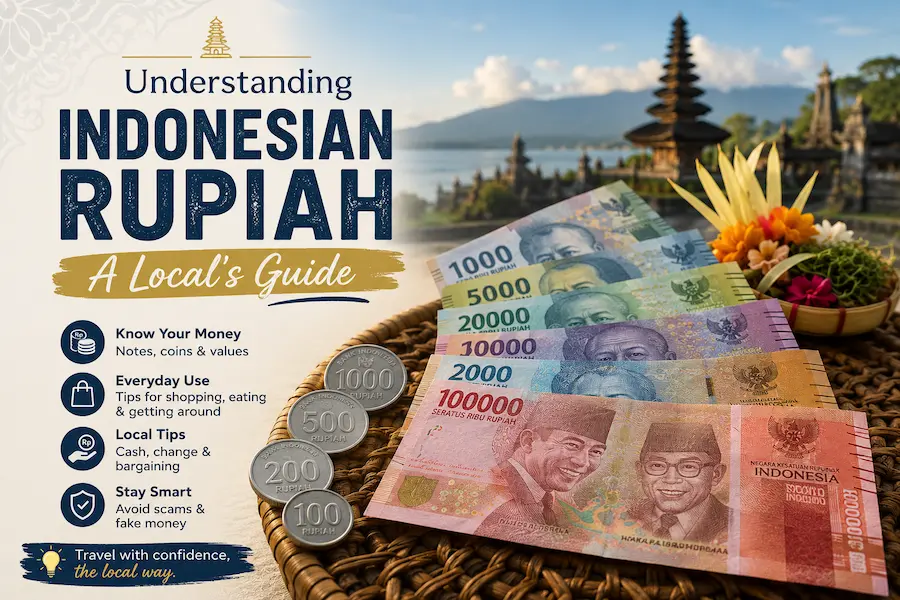
A practical guide to handling Indonesian Rupiah's many zeros — quick conversion tricks, note colors to know, honest local prices, and tipping norms for Bali and Nusa Penida.
A few months ago, a guest handed a warung owner a Rp 100,000 note for a bottle of water. The water cost Rp 10,000. Later that same trip, someone paid Rp 500,000 for a fresh coconut that should have been Rp 15,000. Nobody was trying to overcharge them — they simply miscounted the zeros, and the seller, trusting the note handed over, gave change based on what was offered.
This happens all the time. It's completely understandable. Indonesian Rupiah has more zeros than almost any currency tourists are used to handling, and when everything from a bottle of water to a private tour is priced in the hundreds of thousands, it's easy to lose track. This guide is here so it doesn't happen to you.
The zero problem, solved in one trick
The fastest way to make sense of Rupiah: drop the last three zeros, and what's left is roughly the price in thousands of Rupiah — locals call this "K" shorthand, and you'll see it everywhere on menus and price lists.
- Rp 10,000 = "10K"
- Rp 100,000 = "100K"
- Rp 500,000 = "500K"
For a rough dollar conversion: as of mid-2026, the rate has hovered around Rp 17,950–18,000 to USD 1 (rates shift daily — worth a quick check before your trip). A simple mental shortcut: divide the "K" number by 18. So 100K ≈ USD 5.5, and 500K ≈ USD 28. It won't be exact, but it's close enough to catch a mistake before you hand over the wrong note.
If you'd rather skip the mental math entirely, keeping a currency converter app open (XE, Wise, or just Googling "X IDR to USD") takes two seconds and removes all guesswork.
Know your notes before you land
Indonesian Rupiah notes are colour-coded, which helps once you know what to look for:
- Rp 1,000 / Rp 2,000 — small coins or small notes, used for parking fees and tiny purchases
- Rp 5,000 — brown, small purchases
- Rp 10,000 — purple
- Rp 20,000 — green
- Rp 50,000 — blue
- Rp 100,000 — red, the largest and most common note for daily spending
The two notes that cause the most confusion are Rp 10,000 and Rp 100,000 — both have a similar layout, and in a hurry (or at night) they're easy to mix up. Rp 50,000 and Rp 100,000 also get confused by first-timers, since both are used constantly for tours, meals, and tickets. Take an extra second before handing over a note larger than what's needed — checking the number of zeros, not just the color.
What things actually cost (so you know if a price feels right)
These are typical, honest ranges for Nusa Penida and Bali generally — not inflated "tourist menu" prices:
- Bottled water (small): Rp 5,000–10,000
- Fresh coconut: Rp 15,000–25,000
- Plate of nasi goreng at a local warung: Rp 25,000–40,000
- Parking at a viewpoint: Rp 2,000–5,000
- Nusa Penida entrance/retribution fees: varies by site — see our full cost breakdown
If a seller asks for something far outside these ranges, it's worth a polite second look — not because people are trying to cheat you, but because a miscounted zero goes both ways.
Why "K" shows up on everything
Because writing five or six zeros repeatedly is tedious, most menus, price boards, and even casual conversation shorten prices with "K." A driver quoting "150K" means Rp 150,000, not Rp 150. If a price ever looks suspiciously low, that's usually the reason — a missing "K," not a real bargain.
Tipping in Bali and Nusa Penida
Tipping isn't obligatory but is genuinely appreciated, especially for drivers and guides on a full-day private tour. There's no fixed rule, but many travelers leave somewhere in the Rp 50,000–100,000 range per group for a full day, more for exceptional service. It's never expected loudly — nobody will ask — but it makes a real difference to local drivers.
Cash still matters on Nusa Penida
Bali itself is increasingly card- and QR-friendly (QRIS, Indonesia's QR payment system, is widely accepted at hotels and larger restaurants), but Nusa Penida is a different story. ATMs on the island are limited to a handful of towns — don't assume you'll find one near Kelingking or Broken Beach. As of now: Toyapakeh has a BRI ATM, Banjar Nyuh has a Mandiri ATM, Ped has a BPD (Bank Pembangunan Daerah) ATM, and Sampalan has both Mandiri and BRI. BCA is not yet available anywhere on the island, so don't count on that card working here even if it's your main bank. Card payment at small warungs and stalls is rare to nonexistent. Bringing enough cash from Bali before you cross by boat will save you a lot of stress.
You're not alone
Even locals joke about losing count of the zeros. If you're ever unsure whether you're handing over the right note, it's completely normal to just ask — most vendors, drivers, and guides are happy to help you count it out with a smile.
Skip the math entirely on tour day
One of the small perks of joining a guided day trip: you don't have to think about any of this while you're out exploring. On our Nusa Penida tours, we handle the boat tickets, entrance fees, and logistics — so the only thing you need to calculate is how many photos you're going to take at Kelingking Beach.
Ready to explore Nusa Penida without the money math? Check the full trip cost upfront with our Trip Calculator, or book your day trip with Melali Nusa Penida and let us take care of the details.
For the full rundown on planning your visit — weather, getting there, what to pack — see our Nusa Penida Travel Guide.
Keep reading: planning costs on a budget? See our guide on traveling to Nusa Penida on a low budget, and if you're still deciding where to base yourself, check where to stay in Bali for a Nusa Penida day trip.
Quick recap
- Drop 3 zeros, divide by roughly 18 for a rough USD estimate
- Rp 10,000 (purple) and Rp 100,000 (red) look similar — double check
- "K" = thousand, not a typo
- Bring more cash than you think you need before crossing to Nusa Penida
- A little confusion over zeros happens to everyone — sellers know it too, and it's always fixable with a smile and a recount
Exchange rates are approximate and change daily — always check a live converter before traveling for the most accurate figure.
Related Articles
 Travel Guide
August 20, 2026
Nusa Penida for People Afraid of Heights: The No-Cliff Guide
Scared of heights but still want to see Nusa Penida? Here's every flat, cliff-free spot worth visiting — plus which famous ones to skip.
Read more Travel Guide
August 14, 2026
Nusa Penida 3-Day Itinerary: The Complete Route for First-Timers
A day-by-day 3-day Nusa Penida itinerary covering Kelingking, Angel's Billabong, Broken Beach, Diamond Beach, Atuh Beach and more — plus boat, fee and scooter-vs-driver logistics.
Read more Food & Culture
July 12, 2026
Is Nusa Penida Muslim-Friendly? Honest Halal Food & Prayer Guide (2026)
Is Nusa Penida OK for Muslim travelers? An honest local guide to halal food, the island's single mosque, prayer logistics during a day tour, and how a private tour makes it easier.
Read more